How Much Should You Tip in New York City?
If you’re visiting New York City for the first time, tipping can be confusing. Who should you tip, how much should you give, and what happens when a payment screen suddenly asks for 25%?
The good news is that you don’t need to tip everyone. Here are the basics you need to know.

NYC Tipping Guide
| Situation | Typical Tip |
|---|---|
| Sit-down restaurant | 18–20% |
| Bar / bartender | $1–2 per drink |
| Taxi / Uber / Lyft | 15–20% |
| Hotel housekeeping | $2–5 per night |
| Bellhop / luggage assistance | $2–5 per bag |
| Hotel doorman | $1–5 for special help |
| Tour guide | About 15–20% |
| Food delivery | 15–20% |
| Coffee shop / counter service | Optional |
| Takeout | Optional |
| Food truck / street food | Optional |
| Spa / massage | 15–20% |
Tip at Restaurants
At a sit-down restaurant, 18–20% is a good rule of thumb for normal service. The tip is normally calculated on the pre-tax amount, not the total after tax.
Before paying, check your bill. Gratuity may already be included, especially for larger groups. If it is, don’t tip twice.
If you see a service charge, check what it covers before adding another tip.
Tips on Taxis, Uber & Lyft
For taxis and rideshare services like Uber and Lyft, 15–20% is typical.
You can tip through the taxi payment screen or directly in the Uber or Lyft app, so you don’t need to carry cash specifically for this.
Note: Card readers in NYC yellow taxis commonly show preset buttons of 20%, 25%, and 30%. You can select “Custom” and enter a lower amount if you prefer.
Tipping in Hotels
Cash is useful for hotel tips.
- Housekeeping: $2–5 per night
- Bellhop (luggage assistance): $2–5 per bag
For housekeeping, leave the tip somewhere clearly visible in the room, such as on the bedside table. It’s better to tip daily, since the person servicing your room can change.
Coffee Shops & Counter Service
You’ll often see a tip screen at coffee shops and counter-service restaurants.
You don’t have to tip simply because the screen asks. If you receive exceptional service, you can leave something. Otherwise, choosing $0 or skipping the tip is perfectly fine in many counter-service situations.
What If the Payment Screen Says 25% or 30%?
Don’t feel pressured.
Some businesses may use high preset tip options such as 25% or 30%.
If you don’t want to choose one of the suggested amounts, look for “Custom Tip” or “Other” to enter the amount you want. If tipping isn’t expected, $0 is fine.
Cash or Card for tipping in the US?
Both are fine.
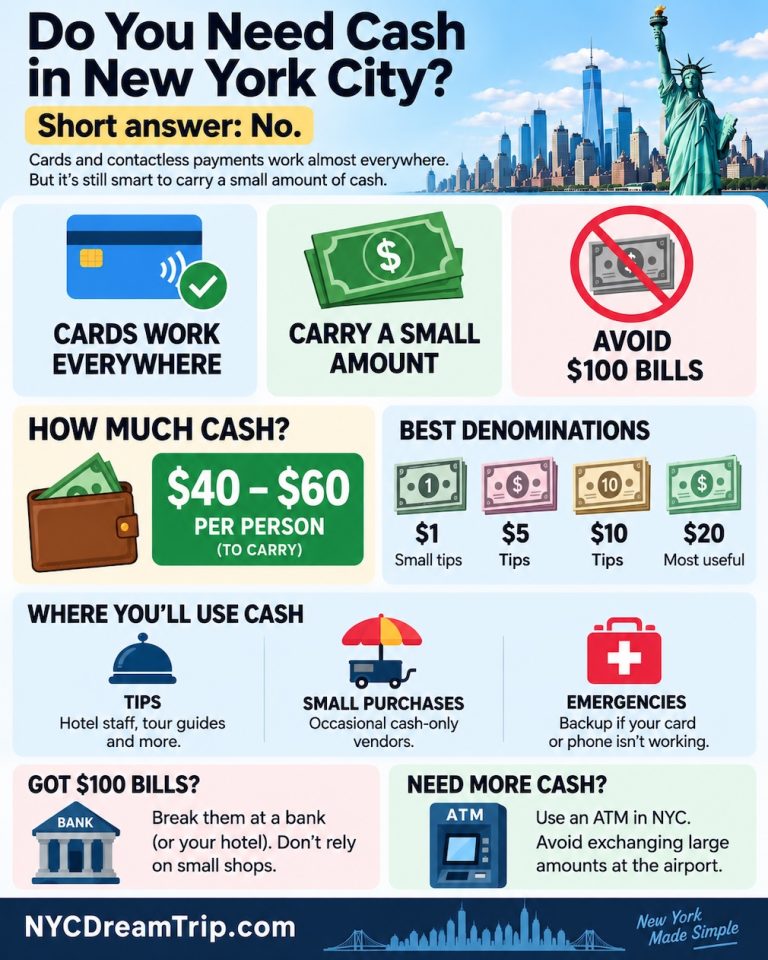
You can tip by card at restaurants and through payment screens for transportation. It’s still useful to carry a few $1, $5 and $10 bills for hotel staff, tour guides and other situations where cash is convenient.
Will Someone Be Rude If I Don’t Tip?
Usually, no one will confront you. But in places where tipping is customary – especially sit-down restaurants – not tipping for normal service can be perceived as rude.
Don’t worry about getting every tip exactly right. Once you know where tipping is expected, it’s pretty straightforward.
Quick Tipping Rules to Remember
- Restaurants: 18–20%
- Taxi / Uber: 15–20%
- Hotel Housekeeping: $2–5 per night
- Counter service, cafes and food trucks: Optional
Frequently Asked Questions
The Story Behind the Tip
Tipping didn’t start in restaurants — it actually started in European homes. Back in 17th and 18th-century England, if you stayed with a wealthy host, you were expected to slip a little cash to the staff who looked after you: this included the footman, the butler, the maid.
It was called a “vail” and it mattered, because servants’ actual wages were often so low that vails made up a real chunk of their income.
Guests hated it, honestly — it felt like being nickel-and-dimed on your way out the door, and English writers spent decades complaining about it.
You’ll find similar habits elsewhere in Europe, too. The French word for tip, pourboire, literally means “for a drink” — the idea being you hand over a little extra so the server can buy themselves one.
And in case you’ve heard that “tip” stands for “To Insure Promptness” that’s a fun story, but it isn’t true. It’s just old English slang for handing something over.
Wealthy Americans picked up tipping on trips to Europe in the mid-1800s and brought it home. At first, Americans actually hated it — it felt like something aristocrats did, tied to servants and social class, and a handful of states even passed laws banning it outright in the early 1900s.
Those laws didn’t last. After the Civil War, hotels and railroads started paying certain workers very little in direct wages and leaning on tips to fill the gap — most famously the Pullman Company, which employed thousands of formerly enslaved Black men as sleeping-car porters under exactly that setup.
That’s really where the modern American system comes from: many states still let employers pay tipped workers a lower base wage, on the assumption tips will close the gap (New York has its own version of these rules).
It’s a big part of why tipping here feels less like a bonus and more like a real chunk of someone’s paycheck — something most European service workers, who’re paid a full wage either way, don’t have to think about.
Restaurant Tipping
No — it’s not a law, it’s a very strong custom. Everyone tips, but nobody is going to fine you for tipping less.
That said, don’t treat it as optional at a sit-down restaurant. Servers really do expect 18–20%, and skipping it for normal service is going to be seen as a mistake, even if it isn’t a legal one.
Always take a second look at the bill before you tip. If you see the word “gratuity” that’s meant for your server — restaurants sometimes add it automatically for big groups, and it’s usually disclosed on the menu ahead of time.
A “service charge” is a little different. It’s a fee the restaurant sets itself, and there’s no guarantee it actually reaches your server — it might cover the kitchen, overhead, or something else entirely. If you spot one and aren’t sure where the money’s going, just ask. It’s a completely normal question.
Sometimes, but there’s no single rule across the city — it really depends on the restaurant. If a place does add a mandatory charge for big parties, it has to tell you up front, usually in small print on the menu, something like “a service charge applies to parties of 8 or more.”
So if you’re eating out with a group, take a quick look at the menu — and check the bill again before you tip.
Not really. If you’re just grabbing a bag of food and heading out, a tip is a nice gesture, not something anyone’s expecting — a dollar or two, or just rounding up, is generous.
Go ahead and hit “no tip” on the takeout screen if that’s your call. Nobody’s going to be offended.
The Awkward Payment Screen
Nope. Those buttons — 20%, 25%, sometimes even 30% — are just defaults the business picked. You don’t have to pick one of them.
Look for a “Custom” “Other” or “No Tip” option and type in whatever feels right, even zero. And nobody at the register is watching your screen or judging your choice.
You’re not imagining it. This is a real, recent shift, sometimes called “tip creep” or “tipflation.”
Card readers like Square, Toast, and Clover come preset with tipping switched on, so even places that never used to expect tips — a corner store, a self-checkout machine — end up asking anyway.
Seeing the prompt doesn’t mean you’re supposed to tip there. It just means that’s how the machine is set up.
Hotels & Personal Services
Only if he actually does something for you — hailing a cab in the rain, holding an umbrella to your car, helping with your bags. A dollar or two covers it.
If he’s just opening the lobby door as you walk through, that’s part of his normal duties. No tip needed.
A quick question; where’s the subway, can you recommend a good dinner spot — doesn’t call for a tip.
But if the concierge does real work for you, like getting you a table at a fully booked restaurant or tracking down sold-out tickets, that’s worth $5–20 in cash, handed over quietly. It’s also a nice move if you think you’ll need another favor later in your stay.
Don’t stress about it. Nobody’s going to chase you down over a missed tip.
Plenty of hotels will let you add a tip to your room bill if you ask at the front desk, and ATMs are everywhere in Manhattan. Grabbing some small bills for the rest of your trip takes about five minutes.
Yes, generally 15–20% — same idea as a restaurant. A lot of spas build the tip right into the checkout screen or receipt.
Handing cash straight to the therapist instead? Do it quietly, rather than at the front desk.
Bars, Delivery & Everyday Situations
It depends how you’re paying. Ordering drinks one at a time and paying cash as you go? $1–2 per drink is standard.
Running a tab and paying it all off by card at the end? Tip 15–20% of the total instead, just like you would on a restaurant bill.
Apps like Uber Eats, DoorDash, and Grubhub will ask you to tip when you place the order, usually with a percentage or dollar amount already suggested. You can change it, and adjust it again after delivery too.
Most couriers are independent contractors, so that tip really does matter to their paycheck — it’s not just a nice extra.
Not really. Even when a screen prompts you, a tip in these settings is more of a bonus for great service than something expected — leaving nothing is completely normal.
Bad Service & Uncomfortable Situations
There’s a difference between “meh” and genuinely bad. A slow or distracted server still gets something — maybe 10–15% instead of 20%.
If something actually goes wrong and nobody tries to fix it, you don’t have to leave the full amount. But one small hiccup in an otherwise fine meal isn’t a reason to leave nothing.
In places where tipping is genuinely expected — a sit-down restaurant, a bar tab — skipping it for normal service is going to come across badly, even if nobody actually says anything to you.
But at places where tipping is optional, like counter service, choosing not to tip is completely normal. It really just depends on where you are.
Nobody can force a voluntary tip out of you — that’s always your call.
What they can enforce is a mandatory charge you were told about before you ordered, like an automatic gratuity for large groups listed on the menu. Once you’ve seen that and ordered anyway, it’s just a normal part of your bill.
Things First-Time Visitors Wonder About
Totally optional. Performers work off donations, not a wage, so give if you liked the show and skip it if you didn’t — nobody expects payment just for stopping to watch.
“Free” walking tours usually mean the guide isn’t getting paid a normal fee — the tip is the pay. If you enjoyed it, $10–20 per person is a common way to say thanks.
Just check the tour company’s own instructions first, since practices vary.
Generally, no. Ticket counters, museum staff, retail workers, and subway or bus staff don’t expect a tip, and you won’t find a tip jar at a turnstile or a store register.
We’ve covered most of the questions visitors ask about tipping in NYC. But if you still have a tipping question, leave a comment below and we’ll do our best to help.